



China's Mars orbiter observes interstellar object 3I/ATLAS









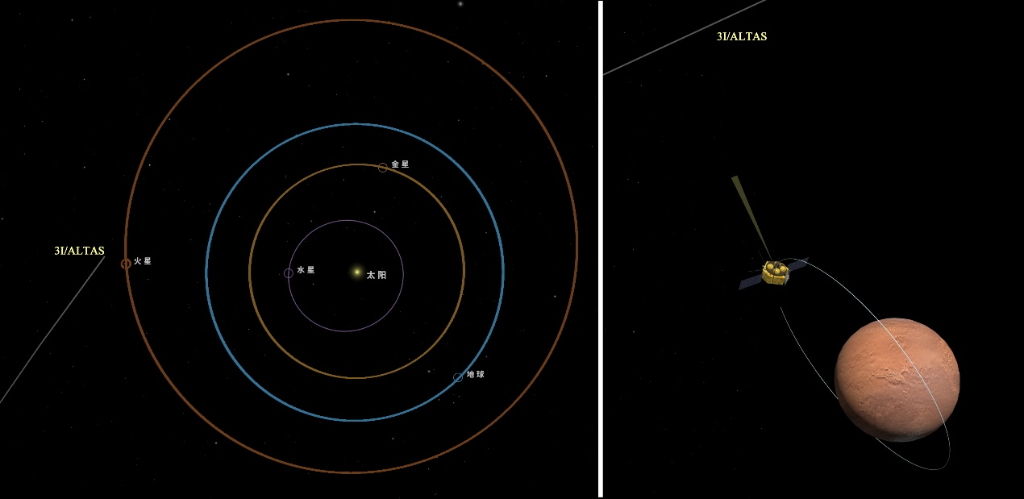
BEIJING -- The orbiter of China's Mars mission Tianwen 1 has successfully observed an interstellar object, coded 3I/ATLAS, using its high-resolution camera, according to the China National Space Administration (CNSA).
During the observation, the spacecraft was about 30 million kilometers from 3I/ATLAS, making it one of the closest observations by a probe of this interstellar object.
Data received and processed by the ground application system showed clear cometary features in the images. Researchers created an animation from a series of images taken over 30 seconds, demonstrating the object's movement through space. These observations are now being used for further scientific study of 3I/ATLAS.
This successful observation represents an important extended mission for Tianwen 1. The detection of such a faint celestial object serves as a valuable technical test for China's Tianwen 2 mission, which was launched in May -- aiming to collect samples from a near-Earth asteroid and explore a main-belt comet, the CNSA said.

Discovered on July 1, 2025, by a survey telescope in Chile, 3I/ATLAS is the third known interstellar object to visit the solar system.
Scientists believe this object likely formed around ancient stars near the center of the Milky Way, with an estimated age of between 3 and 11 billion years -- possibly older than the solar system. This makes 3I/ATLAS a rare sample in studying the composition and evolution of exoplanets, and the early history of stars, holding significant scientific value.
The Tianwen 1 team began preparing for the observation in early September. After repeated simulations and feasibility assessments, they determined to use the high-resolution camera on the orbiter and designed optimal imaging strategies, ultimately achieving successful observation.
China's Tianwen 1 mission, consisting of an orbiter, a lander and a rover, was launched in July 2020. The probe entered Mars' orbit in February 2021 and has been operating stably for roughly four years and eight months.


- Journalists and content creators tour China's past, present and future in Henan
- China's experimental satellite constellation lays foundation for future lunar exploration
- New county established in Xinjiang
- 8,406 suggestions from national lawmakers forwarded for review
- China launches national long-term care insurance program
- Chinese researchers develop high-efficiency thin-film photovoltaic for space energy





